When building or upgrading a Toyota 4AGE 20V engine, it’s easy to focus on major components like camshafts, intake systems, exhaust upgrades, and ECU tuning. However, one critical part of the valvetrain is often overlooked — valve springs. These small yet vital components control valve motion and directly impact engine reliability and performance, especially at higher RPM.
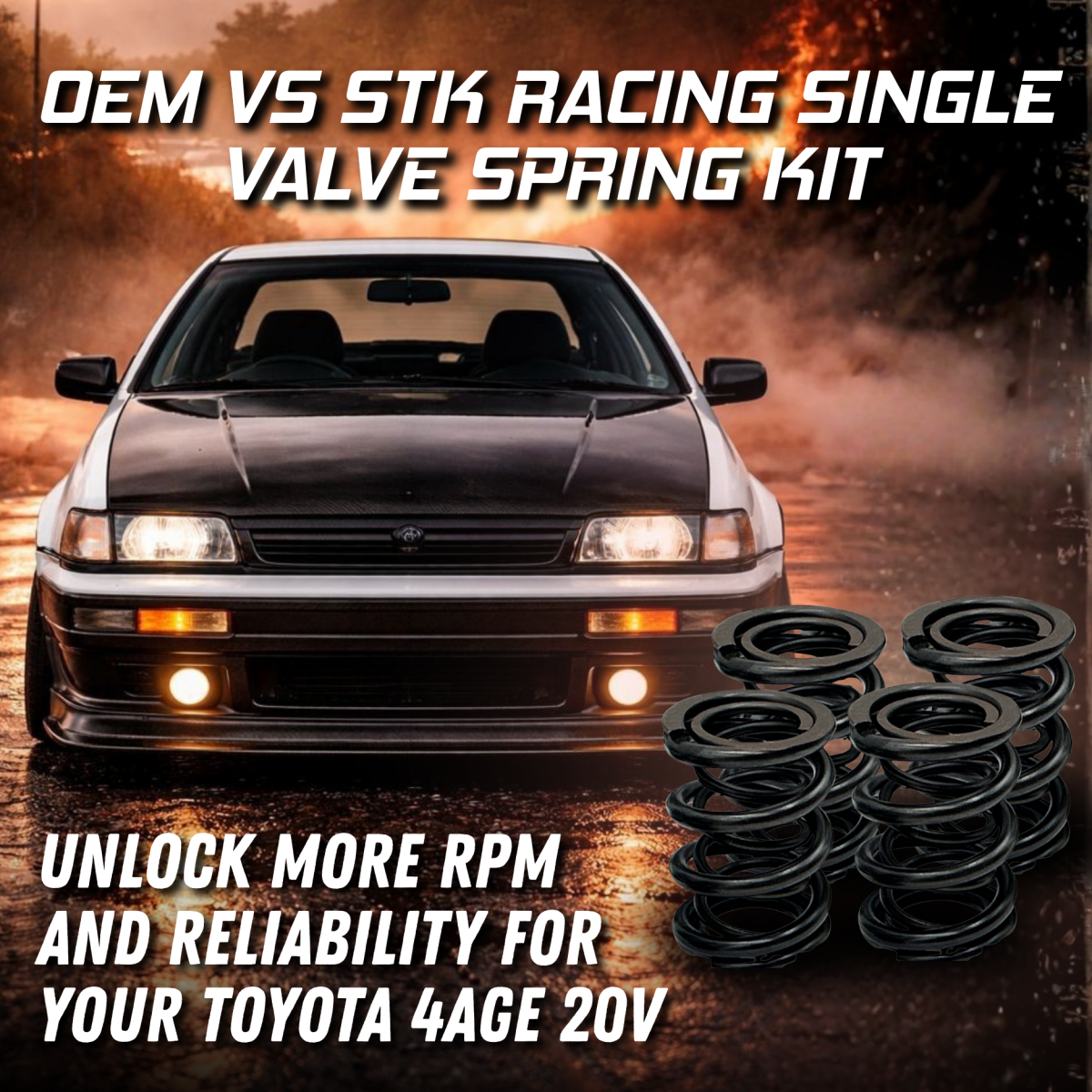
In this article, we break down the differences between OEM valve springs and the STK Racing Single Valve Spring Kit, and explain why upgrading should form part of your performance strategy.
What Do Valve Springs Do?
Valve springs are responsible for closing the engine’s valves in sync with the camshaft’s movement. At lower engine speeds, stock springs typically manage this without issue. But as RPM increases — whether on the street or the track — the demands placed on valve springs rise significantly.
If springs are not strong enough to keep up, valve float can occur. This is when the valves fail to close properly or quickly enough, leading to power loss, unstable running, and in severe cases, engine damage.
OEM Valve Springs — Designed for Factory Conditions
Factory valve springs are engineered for reliability within standard driving conditions. They are designed to:
-
Operate smoothly within stock RPM ranges
-
Provide long service life
-
Maintain predictable performance
-
Match factory camshaft lift and duration
For a stock 4AGE 20V used primarily as a daily driver with minimal modifications, OEM springs are entirely sufficient. They are built to meet Toyota’s original design parameters and deliver dependable operation under normal use.
Where OEM Springs Fall Short
The limitations of OEM valve springs become clear once the engine is modified beyond factory specifications. They were not designed for:
-
Extended high-RPM use
-
Aggressive camshaft profiles
-
Increased lift and duration
-
Forced induction applications
-
Regular track or motorsport driving
Once you exceed factory rev limits or increase cam demand, stock springs may struggle to maintain proper valve control. This increases the risk of valve float and inconsistent valvetrain performance.
STK Racing Single Valve Spring Kit — Built for Performance
The STK Racing Single Valve Spring Kit is specifically engineered for modified and high-performance Toyota 4AGE 20V engines. These springs are designed to handle increased stress and elevated RPM.
Key benefits include:
-
Higher spring pressure to support aggressive cam profiles
-
Improved valve control at high engine speeds
-
Greater resistance to heat and fatigue
-
Enhanced stability under performance conditions
This kit is well suited for engines running aftermarket camshafts, raised rev limits, naturally aspirated high-RPM builds, or turbocharged and supercharged applications.
The focus is not only on increased performance, but also on maintaining reliability when the engine is operating beyond stock limits.
OEM vs STK — Comparison Overview
OEM Valve Springs
-
Designed for stock applications
-
Limited high-RPM capability
-
Not intended for performance camshafts
-
Suitable for daily driving
STK Racing Valve Springs
-
Designed for modified and performance engines
-
Strong high-RPM stability
-
Compatible with aggressive cam profiles
-
Suitable for street performance and track use
When Should You Upgrade?
Not every 4AGE build requires upgraded valve springs. However, an upgrade becomes essential when:
-
Installing performance camshafts
-
Increasing rev limits
-
Building a high-revving naturally aspirated engine
-
Adding forced induction
-
Using the vehicle for regular track or competition driving
In these scenarios, upgraded valve springs are not just about extracting more performance — they are about protecting your engine from potential valvetrain failure.
Final Thoughts
While valve springs may not be the most visible upgrade in a performance build, they play a critical role in how your engine behaves under load. If you plan to push your Toyota 4AGE 20V beyond factory specifications, upgrading to the STK Racing Single Valve Spring Kit ensures improved valve control, consistent power delivery, and greater reliability at higher RPM.
When building for performance, every component matters — especially the ones that keep your engine in control when it counts most.